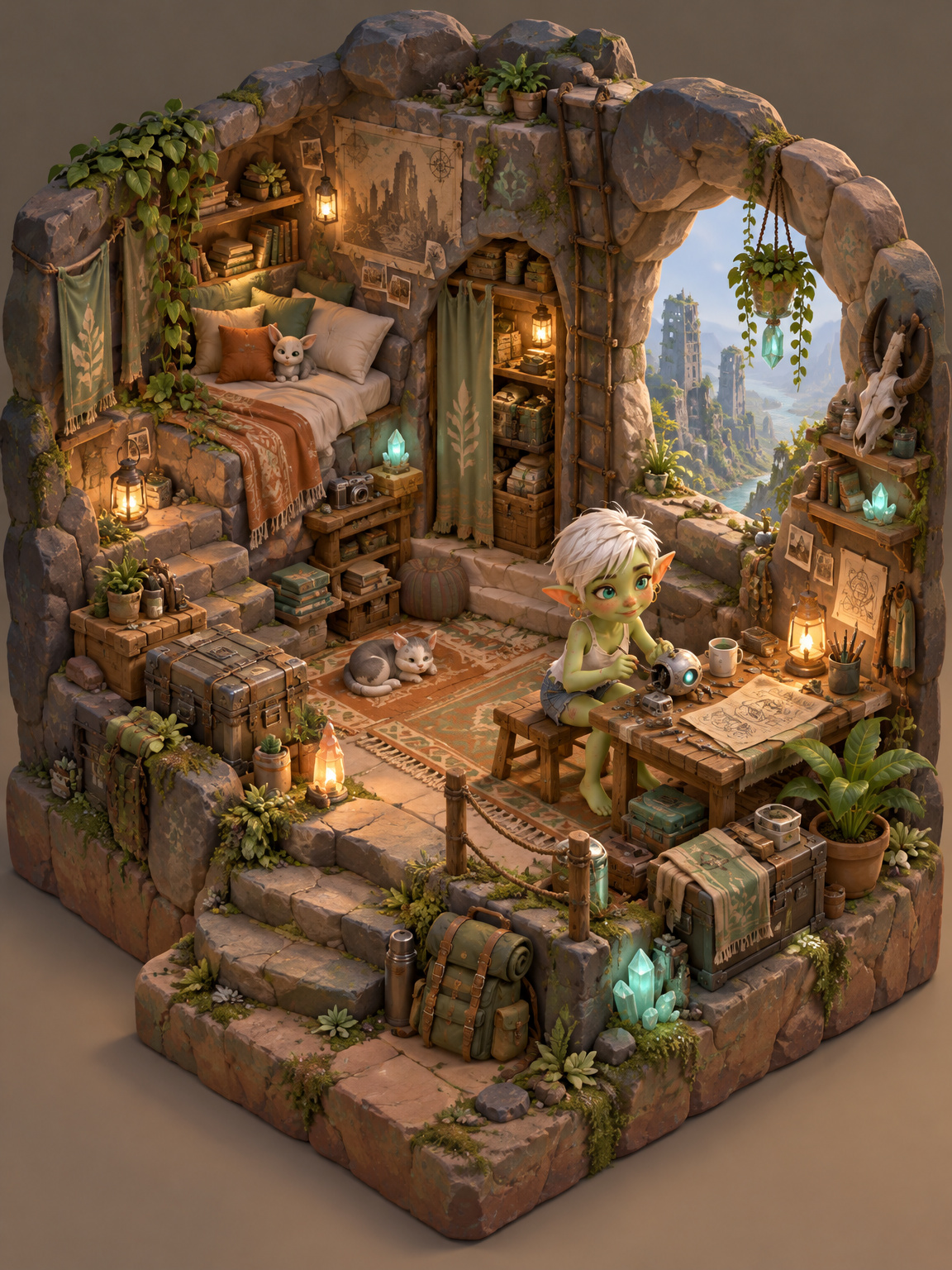
Transform the input character into a stylized 3D isometric diorama — a cute miniature game-world scene with the character living inside it, viewed from the classic elevated three-quarter (dimetric) isometric angle that gives real depth.
Render style (the signature — NOT pixel art): clean, smooth, stylized 3D — soft rounded surfaces, gentle ambient-occlusion shading, soft global illumination, warm tasteful colors, a polished "tiny detailed model" / cozy mobile-game look (Animal Crossing / Cozy Grove / a handcrafted miniature). Crisp and smooth, NOT pixelated, NOT clay or stop-motion.
Identity: render the character as a cute stylized 3D figure inhabiting the scene — keep their hair color and style, eye color, outfit colors and signature accessories, with the face clearly readable. About 30-45% of frame height — the clear focus but a believable inhabitant, correctly proportioned to iso doorways, furniture and props (a doorway taller than the character, a chest about knee-height).
Isometric scene: build the whole diorama on a consistent isometric grid — floor, walls, furniture and props as dimensional iso blocks with visible top and side faces, real 2.5D depth (never a flat side-on or top-down view). A small self-contained scene matched to the character's vibe (cozy bedroom, shop, cafe, garden, dungeon, neon street), with layered props that build a believable little world. Soft drop shadow under the diorama; clean simple backdrop.
Avoid: pixel-art or 16-bit look; flat 2D side-on or top-down view (must be isometric 2.5D with dimensional depth); clay, stop-motion or photographic-miniature texture; photoreal; giant or speck-sized character; mismatched character/scene scale; anime cel-shading; garbled UI text; watermarks.
CHARACTER: reference image
ROOM THEME: cozy cave
ERA: post-extinction era
COLOR PALETTE: reference image, terracotta, granite, pale green, aqua blue,
Create a secret room belonging to the CHARACTER above, designed around the ROOM THEME, set in the ERA, and styled with the COLOR PALETTE. Vertical 3:4 composition.
Present the room as an isometric cutaway miniature diorama, viewed from a slightly elevated three-quarter angle. Remove the roof and two camera-facing walls to reveal the interior. Keep the entire room and its display base inside the frame, with clean negative space around it, consistent perspective, and believable furniture proportions.
Translate the character’s personality, occupation, and backstory into distinctive furniture, architectural details, treasured collections, and everyday belongings. Include a cozy resting area, a personalized workspace, and a concealed storage nook. Make every object feel intentionally chosen and appropriate to the era.
Add subtle storytelling details: a signature possession, an unfinished personal project, a discreetly placed keepsake, and small signs of daily life. Arrange them naturally so viewers can discover clues about the room’s owner. Keep the space richly detailed but never cluttered.
Show the character naturally inhabiting the room, quietly absorbed in an activity that suits their personality. Preserve recognizable facial features, hairstyle, and signature clothing. Scale the character correctly to the furniture, keeping their face and silhouette visible without blocking important room details.
Use warm practical lights balanced with soft ambient light from a window, gentle contact shadows, delicate reflections, and convincing wood, fabric, metal, and glass textures. Match the lighting to the room’s theme while keeping the interior visually readable.
A handcrafted, collector-quality miniature brought to life, with expressive character design, meticulously rendered architectural details, crisp focus across the diorama, rich material textures, cohesive colors, and intimate visual storytelling. No captions, labels, logos, or watermarks.