
0
4
Foundry Saint
Foundry Saint was never designed to be graceful.
It was designed to arrive at something considered immovable and establish that the assessment had been optimistic.
Rook Heavy Industries built the FS-series around a simple assumption: war over infrastructure is pointless if the infrastructure does not survive the winner.
Foundry Saint therefore specialises in entering places other Frames would destroy simply by fighting inside them.
Steelworks.
Freight terminals.
Power plants.
Ports.
Processing facilities.
It can breach them, defend them, recover machinery from them and—if necessary—hold parts of them up.
The last capability is how it earned its name.
Construction
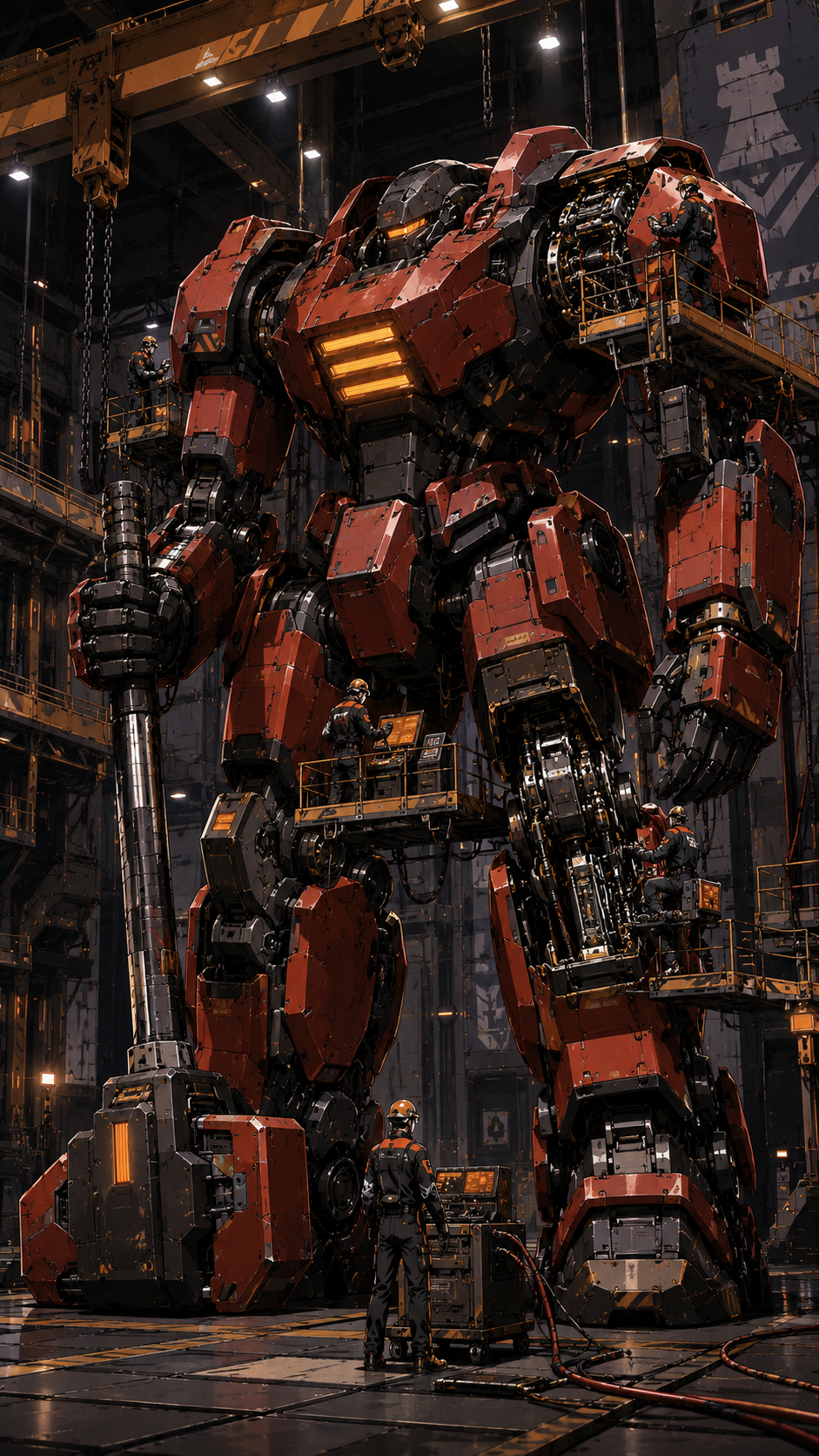
Foundry Saint is built around a dual-spine Loadpath Chassis, a reinforced structural skeleton designed to route impact through the torso, pelvis and legs rather than concentrate stress around conventional humanoid joints.
Its armour is deliberately modular.
Large oxide-red composite blocks can be removed individually by ordinary Rook service crews without requiring a specialised cleanroom or factory refit.
The seams are visible.
The fasteners are visible.
The access points are obvious.
Dr Elara Quist insisted on it.
“If a technician needs a design archive to find the hydraulic manifold,” she once told the development team, “we have built sculpture instead of machinery.”
Beneath the armour sits a charcoal structural frame carrying oversized rotary bearings, hydraulic amplification cylinders and redundant coolant networks.
Foundry Saint can lose systems.
The important ones usually have another route.
Engineering
Its most distinctive system is the Redline Hydraulic Network.
Electric actuators provide ordinary movement, but extreme loads trigger high-pressure hydraulic amplification throughout the arms, hips and legs.
For several seconds, Foundry Saint can produce force far beyond what its normal drivetrain could safely maintain.
That capability comes with heat.
A great deal of it.